
Description
Days of White
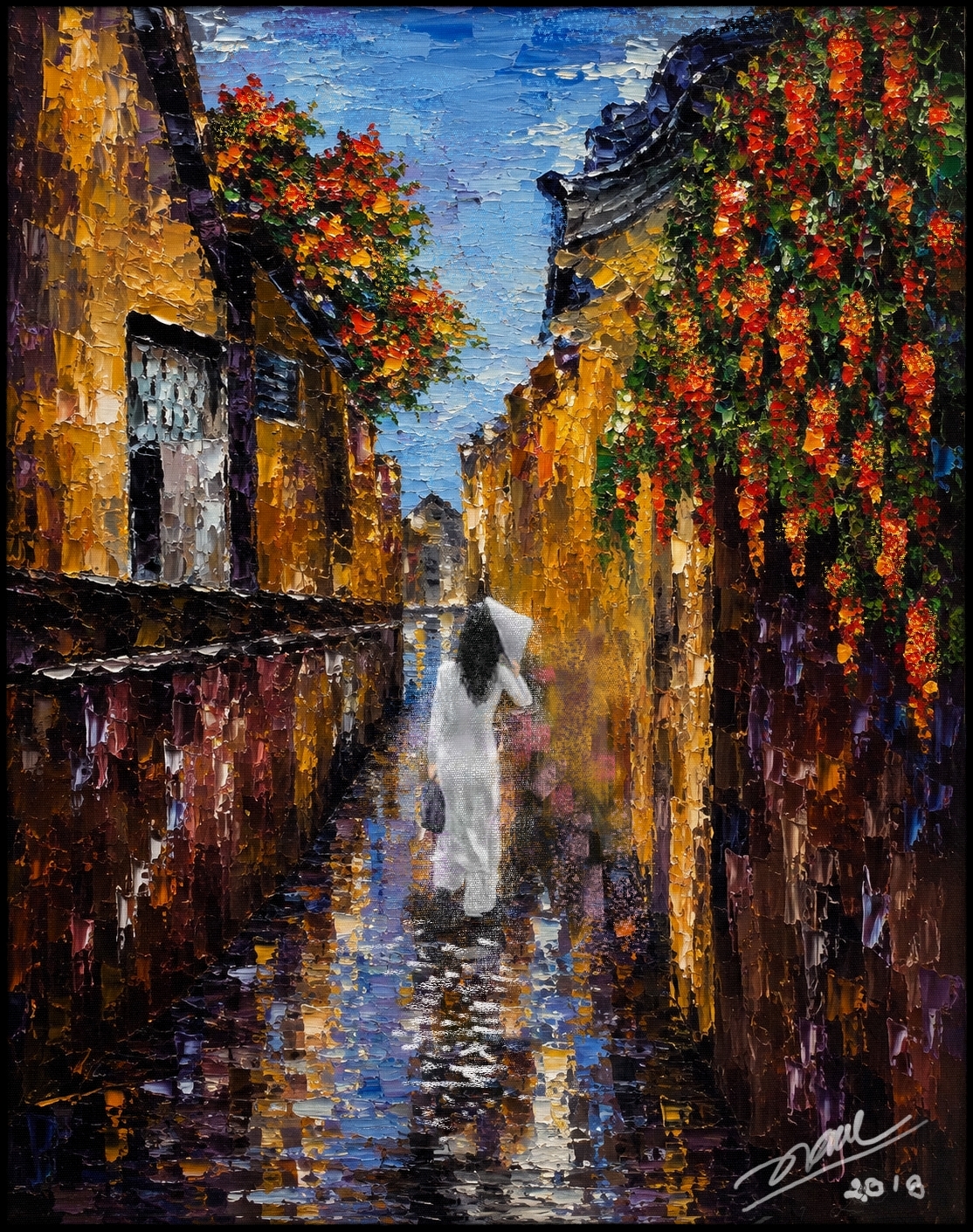
Days of White is a digital painting by Art By Nam, inspired by the nostalgic Vietnamese song Ngày Xưa Hoàng Thị, composed by Phạm Duy from the poem by poem by Phạm Thiên Thư. At the heart of both the song and this painting is a tender memory of youth: a young schoolgirl walking home while a young man quietly follows behind, carrying feelings that perhaps he never finds the courage to express.
In the painting, we see only the young woman.
Dressed in a flowing white áo dài and wearing a traditional conical hat, she walks away from us along a narrow old street. The young man does not appear in the composition. He exists beyond the frame—in the story, in the memory, and perhaps in the position of the viewer himself.
That unseen presence gives Days of White its sense of longing.
A Young Man Following From Afar
There is no dramatic declaration of love in this scene. There is simply a young man following the girl he admires as she makes her way home from school.
Perhaps he wants to walk beside her but is too shy. Perhaps following at a distance is enough. Perhaps she knows he is there—or perhaps she never turns around.
This uncertainty is part of the tenderness of the story.
Many memories of youth are made from moments exactly like these: feelings left unspoken, familiar roads walked again and again, a glimpse of someone from a distance, and small events that seemed insignificant at the time but somehow remained in the heart for decades.
Days of White attempts to preserve that feeling rather than illustrate the song literally.
The White Áo Dài and Memories of Youth
The young woman’s white áo dài becomes the visual heart of the painting.
Against the deep browns, golden walls, brilliant flowers, and dark architecture, her white figure immediately draws the eye. She appears delicate and almost luminous as she moves farther down the street.
Here, white is more than a color.
It evokes youth, innocence, simplicity, and the school days that eventually disappear into memory. The title Days of White refers not simply to the clothing she wears, but to an entire season of life—a time when affection could be expressed through something as simple as quietly walking the same road home.
Years pass. Streets change. People follow different paths.
Yet sometimes one image remains: a girl in white walking ahead.
An Old Street Filled With Memory
The street surrounding her is rendered through rich, expressive texture rather than photographic detail.
Warm yellow and ochre walls rise on either side. Dark roofs and wooden structures frame the narrow passage. Cascading red-orange flowers spill downward from above, while a bright blue sky opens between the buildings.
Below, the wet street reflects the colors around it.
Gold, blue, white, brown, and violet break apart across the surface of the road. The reflections shimmer rather than reproduce the buildings precisely, giving the lower half of the painting an almost dreamlike quality.
That distortion feels appropriate to the subject because memory behaves in much the same way.
We rarely remember every detail of a distant day. Certain things remain vivid—a white áo dài, a familiar street, the color of flowers, perhaps the feeling of following someone home—while everything else gradually becomes softer.
The Person We Cannot See
One of the most important elements of Days of White is actually someone who is not visible.
The young man exists outside the painted scene.
We can imagine him several steps behind, watching the white figure ahead of him. In this sense, the viewer almost occupies his position. We are looking down the street toward the same disappearing figure.
This creates a quiet emotional tension within the painting.
She continues walking.
We continue looking.
And the distance between the two becomes part of the story.
There is affection here, but also restraint. There is beauty, but also the awareness that moments like this cannot remain forever.
When an Ordinary Moment Becomes Precious
As young people, we rarely recognize which ordinary moments will stay with us.
A walk home from school may seem unimportant. A familiar street may seem as though it will always be there. The person walking ahead may simply be someone we expect to see again tomorrow.
Only later do we understand how quickly those days passed.
That is the emotional world behind Days of White.
The painting is not intended to portray sadness alone. It is also a celebration of having experienced such a time at all—the innocence of youth, the sweetness of quiet admiration, and the memories that remain long after people and places have changed.
Perhaps this is why songs and paintings can touch us so deeply. They allow a moment that has disappeared from life to exist again, if only for a little while.
Color, Texture and Emotion
Expressive brushwork gives Days of White much of its atmosphere.
The buildings are formed from layers of gold, brown, violet, black, and orange. Flowers appear as energetic clusters of red and green. The sky opens above in textured blues and whites, while the street below transforms these colors into broken reflections.
Against all this visual energy, the young woman remains quiet.
Her white clothing provides a moment of simplicity within the complexity surrounding her, reinforcing her role as the emotional center of the composition.
From a distance, the painting tells a recognizable story of a woman walking along an old street. Viewed more closely, the scene begins to dissolve into individual textures, marks, colors, and reflections.
Like memory itself, the image exists somewhere between clarity and abstraction.
About This Digital Artwork
Days of White is part of the Art By Nam Digital Painting Collection.
This listing is for a digital download only. No physical painting, printed artwork, frame, or other physical item will be shipped.
After purchase, you will receive the digital artwork file for personal printing and display according to the license terms included with your download.
For the best results, you may use a professional printing service or a suitable high-quality home printer. Printed colors can vary slightly depending on the printer, ink, paper or canvas, print settings, and display used to view the original file.
Any frames, room mockups, furniture, or decorative items shown on the product page are for presentation purposes only and are not included with your purchase.
Days of White is a memory of youth expressed through color—a girl in a white áo dài walking home, an unseen young man following quietly behind, and a moment that passes into the distance but somehow never completely leaves the heart.
The inspiration for this artwork comes from Ngày Xưa Hoàng Thị, a beloved work associated with memories of school days and youthful affection. Readers interested in the musical background can learn more through Phạm Duy’s official website, where the composer discusses how he came to set the poem to music.
Art By Nam — Paintings for a Brighter Tomorrow
Explore more digital paintings–>https://artbynam.com/digital-paintings/
Một Thời Áo Trắng
Days of White – Một Thời Áo Trắng là tranh kỹ thuật số của Art By Nam, được gợi cảm hứng từ ca khúc Ngày Xưa Hoàng Thị của nhạc sĩ Phạm Duy, phổ từ thơ poem by Phạm Thiên Thư. Đằng sau bài hát và bức tranh là một kỷ niệm rất dịu dàng của tuổi học trò: một cô gái trên đường tan trường trở về nhà, và phía sau là chàng trai lặng lẽ đi theo người con gái mình thương mến.
Trong tranh, ta chỉ nhìn thấy cô gái.
Trong tà áo dài trắng và chiếc nón lá, cô lặng lẽ bước đi trên một con phố nhỏ. Chàng trai không xuất hiện trong tranh. Anh ở đâu đó ngoài khung hình—trong câu chuyện, trong ký ức, và có lẽ ngay ở vị trí của người đang đứng ngắm tranh.
Chính sự hiện diện vô hình ấy tạo nên nỗi nhớ của Một Thời Áo Trắng.
Người Đi Theo Phía Sau
Không có một lời tỏ tình nào trong khung cảnh này.
Chỉ có một chàng trai trẻ lặng lẽ đi theo cô gái mình thương trên con đường từ trường về nhà.
Có lẽ anh muốn bước lên đi cạnh cô nhưng không đủ can đảm. Có lẽ chỉ cần được đi phía sau như thế cũng đã là một niềm vui. Có thể cô biết anh đang ở đó. Cũng có thể cô chưa bao giờ quay lại.
Chính điều không nói thành lời ấy làm cho câu chuyện trở nên dịu dàng.
Tuổi trẻ của chúng ta đôi khi được lưu giữ bởi những điều rất nhỏ: một con đường quen, một bóng người phía trước, một ánh nhìn từ xa, hay những tình cảm chưa bao giờ được nói ra.
Khi ấy, chúng ta không biết rằng những khoảnh khắc bình thường đó rồi sẽ trở thành những điều mình nhớ lâu nhất.
Tà Áo Trắng Của Một Thời
Tà áo dài trắng là điểm sáng giữa toàn bộ bức tranh.
Giữa những bức tường vàng, mái nhà sẫm màu, những chùm hoa đỏ rực và con phố đầy sắc màu, bóng áo trắng lập tức thu hút ánh nhìn.
Nhưng màu trắng ở đây không chỉ là màu của chiếc áo.
Đó còn là màu của tuổi học trò, của sự trong trẻo, của những năm tháng mà một tình cảm đôi khi chỉ được thể hiện bằng việc lặng lẽ đi chung một con đường.
Rồi thời gian trôi qua.
Con đường có thể đổi khác. Người xưa có thể đã đi về những hướng khác nhau. Tuổi trẻ cũng không bao giờ trở lại nguyên vẹn.
Nhưng trong ký ức đôi khi vẫn còn một hình ảnh rất rõ:
Một tà áo trắng đang đi phía trước.
Con Phố Của Ký Ức
Con phố trong tranh không được thể hiện như một bức ảnh.
Những bức tường vàng và nâu được tạo nên bởi nhiều lớp màu và nét cọ mạnh. Những chùm hoa đỏ cam buông xuống từ trên cao. Màu xanh của bầu trời mở ra giữa hai dãy nhà, dẫn ánh mắt người xem vào sâu trong con phố.
Dưới chân cô gái là mặt đường ướt phản chiếu tất cả những màu sắc ấy.
Xanh, vàng, trắng, nâu và tím hòa vào nhau, vỡ thành những mảng màu lung linh.
Những hình ảnh phản chiếu không còn hoàn toàn rõ ràng.
Và ký ức cũng vậy.
Sau nhiều năm, chúng ta không thể nhớ hết mọi chi tiết của một ngày xa xưa. Nhưng có những điều kỳ lạ vẫn còn nguyên: màu của một chiếc áo, một con đường quen thuộc, những chùm hoa bên phố, hay cảm giác được lặng lẽ đi phía sau một người mình thương.
Người Không Có Trong Tranh
Có lẽ nhân vật đặc biệt nhất của Một Thời Áo Trắng lại chính là người mà chúng ta không nhìn thấy.
Đó là chàng trai đang đi phía sau.
Anh nằm ngoài khung tranh.
Nhưng khi đứng trước bức tranh này, người xem gần như đang đứng vào vị trí của anh: nhìn theo cô gái áo trắng đang từng bước đi xa hơn trên con phố.
Cô vẫn bước đi.
Ta vẫn nhìn theo.
Và khoảng cách giữa hai người dường như trở thành một phần của câu chuyện.
Trong đó có tình cảm, có sự e dè, có vẻ đẹp của tuổi trẻ, nhưng cũng có một chút bâng khuâng khi ta biết rằng không có khoảnh khắc nào có thể tồn tại mãi mãi.
Khi Một Điều Bình Thường Trở Thành Kỷ Niệm
Khi còn trẻ, ít ai biết được khoảnh khắc bình thường nào rồi sẽ theo mình suốt đời.
Một buổi tan trường có thể chỉ là một buổi tan trường.
Một con đường quen tưởng như ngày mai vẫn còn đó.
Một người đi phía trước tưởng như ngày mai mình vẫn sẽ gặp lại.
Chỉ khi nhiều năm đã trôi qua, chúng ta mới hiểu rằng có những ngày rất bình thường nhưng lại không bao giờ trở lại.
Đó chính là cảm xúc mà Một Thời Áo Trắng muốn giữ lại.
Bức tranh không chỉ nói về nỗi buồn hay sự tiếc nuối. Nó còn là niềm hạnh phúc vì trong cuộc đời, chúng ta đã từng có một thời như thế—một thời tuổi trẻ, một thời thương mến thật nhẹ nhàng, một thời mà đôi khi chỉ cần được đi phía sau một người cũng đủ làm cho một con đường trở nên đáng nhớ.
Có lẽ vì vậy mà âm nhạc và hội họa có thể chạm vào lòng người.
Chúng cho phép một khoảnh khắc đã đi qua được sống lại thêm một lần nữa.
Màu Sắc, Nét Cọ Và Cảm Xúc
Một Thời Áo Trắng sử dụng những lớp màu đậm và nét cọ giàu biểu cảm để tạo nên không khí của con phố.
Vàng, nâu, tím, cam và những khoảng tối tạo nên kiến trúc hai bên. Những chùm hoa đỏ và xanh đem lại sức sống, trong khi bầu trời xanh phía trên mở rộng không gian.
Tất cả những màu sắc ấy lại xuất hiện một lần nữa trên mặt đường dưới dạng những hình ảnh phản chiếu.
Giữa thế giới đầy màu sắc đó, cô gái áo trắng vẫn lặng lẽ bước đi.
Nhìn từ xa, người xem thấy một con phố và một bóng người. Khi đến gần hơn, cảnh vật dần tan thành những mảng màu, nét cọ và lớp texture.
Cũng giống như ký ức—có điều vẫn còn rất rõ, nhưng có điều đã hòa vào thời gian.
Về Tác Phẩm Kỹ Thuật Số
Days of White – Một Thời Áo Trắng thuộc Art By Nam Digital Painting Collection.
Sản phẩm này là tệp tranh kỹ thuật số để tải xuống. Bạn sẽ không nhận được tranh in, khung tranh hoặc bất kỳ sản phẩm vật lý nào qua đường bưu điện.
Sau khi mua, bạn sẽ nhận được tệp tranh kỹ thuật số để in và sử dụng cho mục đích cá nhân theo các điều khoản đi kèm với sản phẩm.
Để có kết quả tốt nhất, bạn có thể sử dụng dịch vụ in chuyên nghiệp hoặc máy in chất lượng cao phù hợp. Màu sắc của bản in có thể khác đôi chút so với hình ảnh hiển thị trên màn hình, tùy thuộc vào máy in, mực, giấy hoặc canvas và các thiết lập in.
Các hình ảnh tranh có khung, phòng trang trí, nội thất hoặc phụ kiện xuất hiện trên trang sản phẩm chỉ nhằm mục đích minh họa cách trưng bày và không được bao gồm trong sản phẩm tải xuống.
Một Thời Áo Trắng là một kỷ niệm tuổi trẻ được kể lại bằng màu sắc—một cô gái áo trắng đang trên đường về, một chàng trai không xuất hiện trong tranh nhưng vẫn lặng lẽ đi theo phía sau, và một khoảnh khắc đã đi xa nhưng dường như chưa bao giờ hoàn toàn rời khỏi ký ức.
Art By Nam — Paintings for a Brighter Tomorrow

Reviews
There are no reviews yet.